


When it comes to BLOBs and SLOBs, are you a one-shape fits all or an assortment of favorite plays regardless of how it starts? If you’re of the opinion to just throw it to halfcourt and get it in to run offense, then this conversation will be of no interest to you – and we are not the same.
SIDE OUT
All out of bounds plays are free kicks; a time to be aggressive and think score. Don’t ask for anymore soccer analogies – this is all I know. Point being, these are quick hitter opportunities to exploit a matchup during a dead-ball situation without taking a timeout. My sideline out of bounds playbook was pretty thin and is probably one of many mistakes I made during my high school head coaching days. For the most part, over a 5-year span at the same program I operated SLOBs with only 3 plays depending on the situation.
- Getting it in versus a deny in late game situations – not concerned with scoring.
- Late shot or game-clock needing a 2 or 3-point play that very possession.
- Any other time during regulation that didn’t fall into the previous 2 situations.
My get-it-in play was the everyday coach’s stack or line call with mixing cutters to find the first person available. During late-game situations I used a set from my playing days before it was popularized as the Brad Stevens Winner.
The every-down sideline out of bounds was a multi-scoring option including a shuffle screen-the-screener. One of the reasons I kept it all the same year-over-year was that the actions were flexible. One possession could include a full reverse for the shuffle, the next could’ve been a hold for a backdoor. Or if we ever ran it all the way through – which was rare – it’d flow into a screen-the-screener, which also could open up to double stagger options. While it was only one play call, there were 4 to 5 different ways to exploit a defensive vulnerability. Regardless, I wish I had opened up the playbook a little bit more to mix it up.
Same Shape Different Sets
I am a proponent of keeping the formation all the same so it’s less to script. When scouting opponents you look at where players are positioned during inbounds or anything that deviates from the norm. Therefore, when everything looks the same to start it’s hard to give defending players a heads up from the sidelines until the bullets are already flying. This was our go-to shape for the majority of our calls at the high school level:
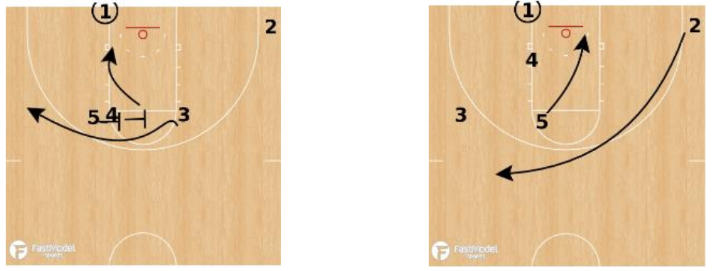
Options included:
- Backdoor 3 & Screening 4 with 5
- Double Away 4 & 5 for the 3
- 3 Splits 4 & 5 then 5 screens the 4
- Double Away for 3 then initiate shuffle screen the screener
- Double Away for 3 then immediate post entry for 1; double decoy for 2
There’s over 10 different actions we could coordinate from a call standpoint all within the same setup. One of the problems that can occur; players had a tendency of blending actions and forgetting the difference between play #1 to play #8.
Thing is most actions can be executed despite the initial alignment: box, 1-4 low, diamond, etc. So, is it more beneficial to the players having a few plays per formation?
From a scouting standpoint, I hope every opponent we play has 10 different alignments, or just decides to throw it deep. My preference for out of bounds situations is to take advantage of a scoring opportunity. And if putting together a playbook again, I’d expand my list of options from a sideline standpoint and vary the shape of all the plays starting baseline out of bounds.

 Coach's Climb