


Started a new book recently to continue thinking more critically from a business perspective.
The Entrepreneur Mind was written by Kevin D. Johnson, the President and CEO of Johnson Media Inc., and senior lecturer at MIT Sloan School of Management. Subtitled “100 Essential Beliefs, Characteristics, and Habits of Elite Entrepreneurs,” the book covers talking points with bite-sized pages divided over 7 core principles:
- Strategy
- Education
- People
- Finance
- Marketing and Sales
- Leadership
- Motivation
As a reminder, it has been a while since adding Negotiating 101 to the bookshelf; the purpose of these recaps is to take any words of wisdom, lessons, or parables that could add transferable value to any of our own coaching endeavors.
It All Starts With Strategy
The very first page asks 3 vital questions:
“Where are we now? Where do we want to be? How do we get there?”
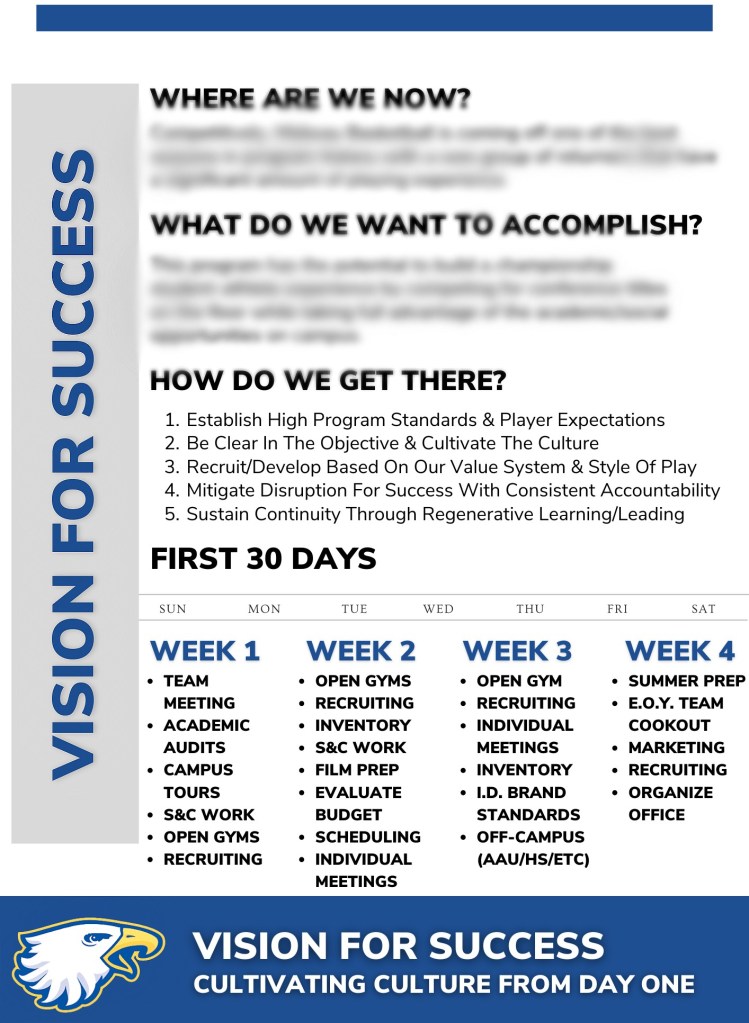
Every coach has to answer those 3 questions. If acting as an assistant in the staff meeting, then the expectation is figuring out how to support the mission. The head coach on the other hand is expected to lay out the blueprint. As a result, this has now been stolen and added to my coaching portfolio moving forward.
Strategy is simply a synonym for an idea, and ideas are rarely unique. Every entrepreneur, similar to every coach crafts a strategy for success. It is the execution plan that separates those from the competition.
“If you are banking on the merit of your idea and not the efficiency of its execution, then you are headed for trouble (83).”
Then how do we execute? Let’s talk about these 3 concepts, in particular:
- Stack The Deck
- Have Laserlike Focus
- Find An Enemy
Stack The Deck
I have heard this phrase thrown around a few times, and a like it for a couple reasons. One, it seems like a great team slogan, mantra, or whatever slapped on a t-shirt. Two, it comes off as actionable and with a competitive connotation.
My interpretation of stacking the deck is about mitigating risk by taking actions that ultimately reduce the odds of failure, subsequently increasing the odds of success. So, from a coaching perspective having high talent plus a strong collective work ethic lowers the odds of failure. As would adding team/staff chemistry, or implementing an intentional strength program specific to program priorities. Stacking the deck builds layers of advantages, and avoids the vulnerability of being one-dimensional.
Have Laserlike Focus
Stacking the deck is easier said than done though; it takes laserlike focus to see expenses turn into profits. Therefore, all attention targets revenue-generating behaviors, let’s keep it to sports:
- Setting a screen when expected, not whiffing or simply interchanging
- Not dismissing high communication drills/activities
- Sacrificing what may be momentarily fun for conduct detrimental to progress
- Embracing a role that best fits the team
- Being a pro when it comes to player & personal development
Some of those felt personal, but are just some general ideas. Business, sports, or the game of life itself revolves around competition. If indifferent to sustaining the positive momentum of productivity, then the outcomes tend to be at the mercy of letting the chips fall where they may. Champions must be different.
Find An Enemy
Rivalries exist out of envy and pursuit of being distinguished as the best. Author Kevin Johnson references the Microsoft and Apple rivalry or Pepsi vs Coca-Cola. The two things in common between each example despite the rivalry, both are formidable in their own respect.
“Implementing this basic gamification strategy enhances your competitive spirit and at least makes business a lot more exciting for everybody (85).”
Choose an enemy that is where you want to go and investigate the why, how, and what within that organization. These are the aspirations of the inspired, and there is a reason why particular brands are associated with success.


 Coach's Climb
One thought on “The Entrepreneur Mind: Strategy”