

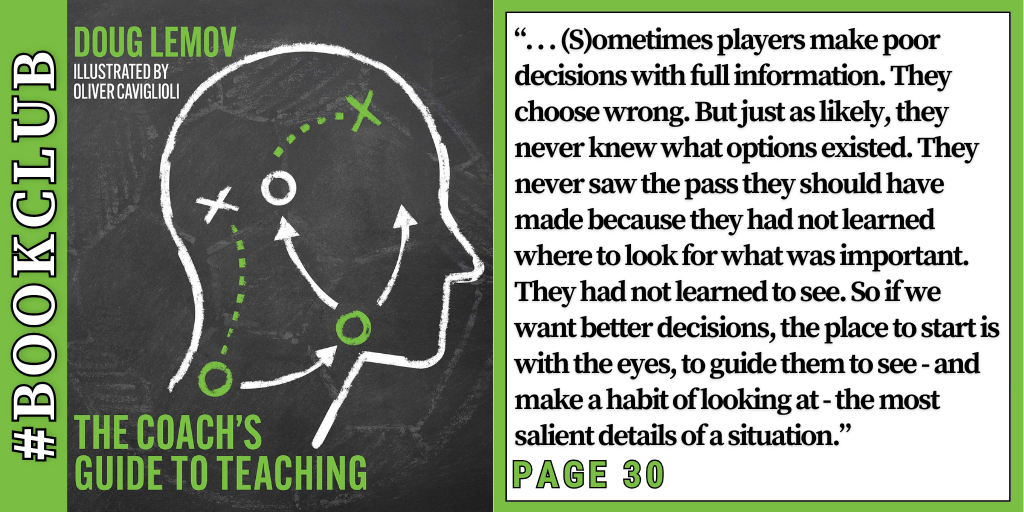
Key Takeaways:
- Prioritizing Perceptive Efficiency
- 3 Types of Training: Skill Acquisition, Game-Based, & Tactical
- Knowledge is Power
This book has been talked about within the coaching community since it first hit the shelves, and despite owning The Coach’s Guide to Teaching for over a year, I am just now getting around to reading it.
First impression is this should’ve been a textbook offered in my graduate level coaching course. That’s not a knock, it’s just my way of saying that I am almost certain the author is too smart to be a coach. Which is not inaccurate considering the author – Doug Lemov – introduces himself as a former teacher and administrator with a passion (background) for soccer.
“There are hundreds such aspects of teaching to optimize and systematize, each with the potential to yield remarkable returns. It’s not just that teaching is a form of competitive advantage but that it is full of a hundred opportunities for a 1%-better-per-day gain that is suddenly a game changer.”
It’s been a while since I’ve contributed to the #BookClub, and no better time to clean the dust off these pages than during the off-season. Eventually we’ll cover 4 segments from this book, starting with discussing chapter one – The Ability To Decide. During the introduction portion of the book, Lemov references how coaches/programs approach with a Moneyball mentality, aiming to find any competitive advantage scouring information or indicators for improving success – let that be our objective here.
Prioritizing Perceptive Efficiency
Results hinge upon an accumulation of decisions. Knowing what to do is one thing, but doing it at the right time can separate a scoring opportunity to a turnover.
“To perceive is to prioritize.”
Players will act upon visual cues based on the speed of the game, then instinctively select a best possible outcome. Where to look or how a player decodes a visual cue is based on the caliber of coaching we’ve done to deduct opportunity vs threat. The speed of that decision is perceptive efficiency.
This understanding for spacing and positioning was one of the biggest adjustments I had to make when transitioning from high school to college as a player. During youth leagues all the way up to high school; man-to-man defense literally meant do not let my matchup get the best of me. Did I learn about help defense somewhere in between? Of course. But by in large, court mapping or perceptive efficiency was a non-existent concept up until I got to the college level.
None of our programs include a Jokic on roster. So we are all in the process of attempting to teach our players how to read a defense or how to neutralize offensive threats from anticipated action. The author breaks down how perceptive efficiency is a combination of knowledge and experience to improve a player’s ability to decide:
- Athletes must have extensive exposure to the geometry of the game.
- Consistently guiding players’ eyes to find the signal amidst the noise.
- “What decision should you make here? Or, what do you see?”
- Constantly improving player mechanics.
Basketball is referred to as a “group-invasion game” where 5 players on offense look to manipulate space occupied by 5 others on defense. Our task as coaches is to implement a system or style of play that helps players see how to expand and exploit any defense while shrinking the gaps of opposing offense.
3 Types of Training: Skill Acquisition, Game-Based, & Tactical
There is nothing like putting together a perfect practice plan, and kudos to the ones that can actually stick to the time frames initially slotted for each segment. Let’s get past the point of thinking we know the best drills to actually use and acknowledge that there are at least 3 types of training where we can all choose from: skill acquisition, game-based, and tactical.
“In such environments, you can do the right thing and be unsuccessful (and thus have it appear that you were wrong); you can do the wrong thing and have it appear to have been right. Clarity emerges in the aggregate.”
SKILL ACQUISITION
Without skill development players are incapable of even performing an activity to make a proper decision. Thing youth basketball camp where every player is yelling “here or I’m open.” It’s difficult for a player to decide between pass, drive, or shoot when all 3 lead to a turnover. This is why fundamentals are a pre-requisite for positive decision-making, and maybe why coaches will still use on air drills without a defender.
GAME-BASED TRAINING
Now, if you throw in a few daunting defenders it becomes game-based scenarios which also are referred to as small-sided games (SSG). Activities could be a simple playground version of 2v2 and 3v3, or structured intentionally where one team starts with an advantage or disadvantage. Players can optimize reps in SSGs to familiarize themselves with the pace, physicality, and geometry of the game.
TACTICAL TRAINING
A tactical activity is considered a little different than game-based for covering specific situational understanding; for example, something our program rehearses quite a bit is the free-throw block out. This is preparing players how to play within the context of the situational game management. It’s not always the point-guard’s job to be the “coach on the floor” when 4 other players are responsible for understanding time and score.
Knowledge Is Power
I will use the line frequent with our teams, “If you know teach then teach, and if you don’t, ask.”
Decision-making doesn’t happen in a vacuum. Players learn differently and rely upon each other to strengthen their understanding for how to read the game together. In The Coach’s Guide to Teaching Lemov discusses 3 tools to help coaches build knowledge within a team:
- Having a curriculum as a development guide (e.g. positional development over time)
- Principles of play serve as a clear tactical philosophy for all phases of the game
- Understood list of terminology
Let’s consider the phase for transition offense:
- When should a player look to play ahead in transition?
- If going from primary to secondary, what are the reads or options that players can use?
- How should a player communicate to the rest of the team flowing into another action?
Illuminate the reads from working on the floor or in the film room and enhance player understanding via consistent language that enables strong retention for future decisions.


 Coach's Climb
One thought on “The Coach’s Guide To Teaching: Ability To Decide”