

Key Takeaways:
- How Culture Is Designed And Shared
- Characteristics of Successful Culture
- Coaching Performance, Not Potential
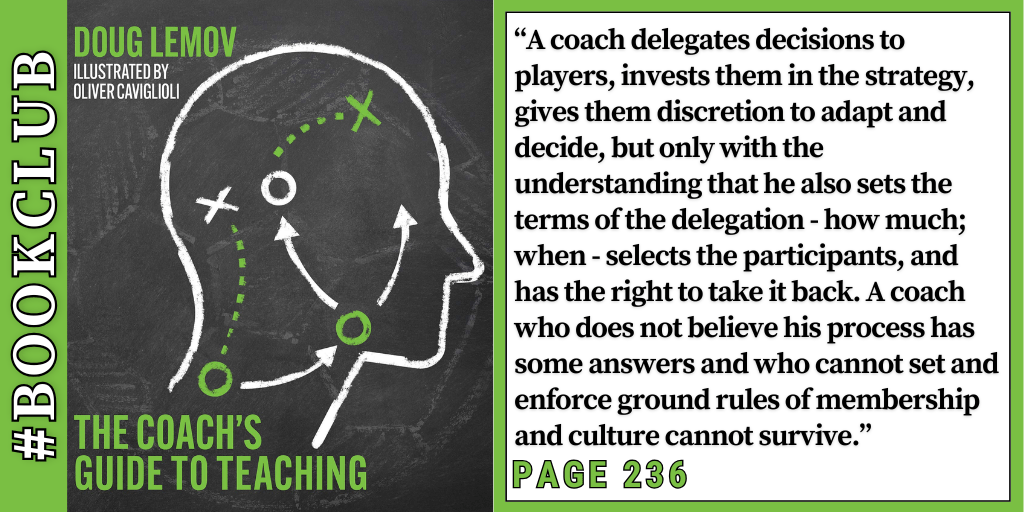
It is the grand finale of The Coach’s Guide To Teaching; the book finished up with chapters on building a positive culture and player/professional development. Both of these topics would likely land on a bingo card for discussion topics during a coach’s press conference; culture likely being the free square. It is the number one priority for coaches to establish, and any audience’s litmus test for gauging future program priorities.
“Culture is built, sustained and transmitted across an organization indirectly: communicated in a series of small moments, many of which occur when you’re most distracted by other things.”
Regardless how the press conference goes, culture is shaped over time, and can constantly change based on what is intentionally designed or inadvertently tolerated. While coaches communicate a vision, ultimately it is the players that walk-the-walk embodying the actual experience. Here’s how the author, Doug Lemov lays out culture being built and maintained:
- Culture is designed . . .
- . . . and it must be shared.
- It must be distinct.
- It is expressed in habits . . .
- . . . and language is the most important habit.
Quick story, and I have no idea where I may have taken it from, but during one of my seasons as a head coach at the high school level we had a tremendous senior class that varied in leadership style and work ethic. One senior in particular carried the torch: an active voice with a daily approach to practice, and a win-first-mentality. Still, he faced challenges trying to reach everybody because his standards didn’t always match the rest of his teammates, sometimes leading to confrontation. After one of our games, our staff approached the Senior to offer a simple reminder, “Lead with substance.” Seem to resonate with him; his attitude shifted to more big brother than drill sergeant and appeared to play with more trust. Subsequently, our entire locker room felt more connected throughout the season.
Compete with substance. Communicate with substance. It’s hard to define, but was described to our players as being more than just a silhouette of what we’re supposed to be doing or the words that we’re saying. Looking back from that season this became a bit of a lesson to myself, understanding the adhesiveness of language and the impact behind what we say, or sometimes choose not to say.
“Trust is an outcome of feedback as much as a prerequisite.”
Characteristics of Successful Culture
It’s a wall with all the words. No, it’s a t-shirt that says #Toughness. Wait, one more. It’s the huddle being broken down while counting to 6 instead of 3 because we over me.
Jokes aside – any one of those tactics can contribute to having a successful culture. Only, if that team truly believes in them, and that belief is contingent on trust.
I’m going to give the author’s 5 characteristics of a “positive learning culture” with what I would consider the 5 most influential attributes to a successful culture.
FROM THE BOOK
- Culture of Error – “Psychological Safety”
- Inclusion & Belonging
- Attentiveness
- Excellence
- Character & Candor
MY OWN TOP 5
- Consistency
- Respect – Trust – Loyalty
- Competitive Character
- Comprehensive Investment
- Brand or Program Identity
This tends to be merely an argument over semantics, but there is probably a heavy overlap among coaches on what a successful culture consists of despite the different terminology used to describe it. Also, yes the competitive character is absolutely stolen from Brad Stevens, which may or may not have been stolen by someone else because that’s what we do.
Any successful culture has to prioritize being competitive, with an expectation of pursuing championships opportunities on a consistent basis. The years that doesn’t happen might be due to deficiencies that exist within the culture of the program from other aforementioned attributes. This could stem from a lack of inclusion or respect within the locker room. Or, inconsistencies, which I would associate with clarity of standards.
Consistency can be the biggest challenge in sustaining culture because every situation is unique to the individual. Continuity of leadership is the best chance to mitigate inconsistency. Pains me to say this as a Bengals fan, but Mike Tomlin of the Pittsburgh Steelers has not had a losing season in the NFL during his 18-year tenure. He should be a case study for all coaches – and administrators for that matter – being provided the opportunity to develop over time, “the standard is the standard.”
Coaching Performance, Not Potential
The final chapter focused on development, from a player and professional standpoint. Coaches are enamored with potential, myself included. We see someone on the recruiting trail or during an open gym make any sequence of impressionable plays and our minds immediately go to how they could be integrated into future plans for the program.
“The mistake isn’t in guessing wrong; it’s in betting too heavily on the guess – even at elite levels. We think we see the future, but we don’t.”
How many of the kids we saw potential in, ended up underachieving? This is a type of example the author uses did indicate a false equivalence between potential and performance, particularly when it comes to fostering an equitable environment for player development. There are countless steady performers – without an advantageous size or enviable athleticism – that have lost out on reps to teammates where coaches saw more potential than real results.
“Some of the kids we coach the very worst are the kids who dominate when they are young. We let them become limited and one-dimensional players to keep the wins coming.”
However, such is sports. There are always bigger, stronger, quicker, and more athletic athletes competing for limited playing time, whether in practice or during the game. Depending the competitive level and expectations to prioritize winning now in order to continue coaching tomorrow; decisions have to be made on which players will be entrusted to get the most opportunities.
The truth: if one kids potential has a higher ceiling than another without drastically compromising the team’s probability to win, then that is likely who will receive the bulk of the reps. But even that comes with a delicate balance because a steady performer with proven ability, yet maybe slightly less skill, cannot be ignored to the extent of losing buy-in.
Competition doesn’t stop after playing days are over. Employers will also participate in the potential over performance conversations during the hiring process. I believe that is where many believe politics come into play, or otherwise referred to as, “Not what you know, but who you know.” Let the inequity of playing time be a life lesson for us as coaches. Despite possibly being a harder worker, or even the more accomplished, you are never guaranteed anything other than failure if you never try or quit.
“It’s natural to want to be recognized for one’s performance and achievements, to take pride in one’s work, to want to be the best. After all, coaching is a competitive profession; everyone pursues recognition to some degree.”


 Coach's Climb