

Key Takeaways:
- Seeking Wisdom, Wherever It May Be Found
- Create Order From Chaos With Structure
- Stewardship Coaching
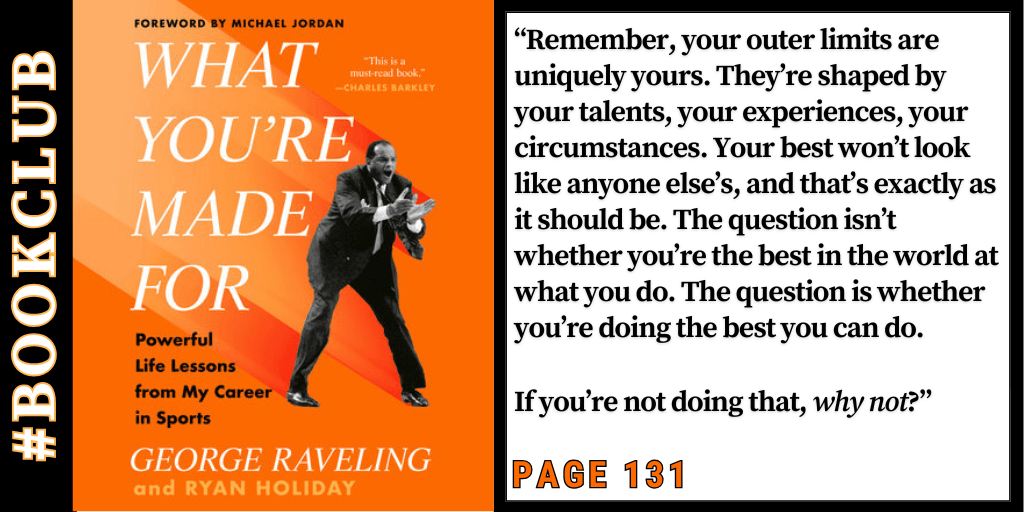
My exposure to George Raveling didn’t really start until after his retirement from coaching, and what I quickly learned about him off the floor was his passion for reading. If you ever visited his website or came across his social media, then you would’ve seen the impact books had on his life. What You’re Made For allowed Coach Raveling to share not only how important reading was in his life, but how life lessons really started from listening.
“Looking back, I realize now that my grandmother and her friends were my first audiobook. She didn’t just bring me along to listen; she curated experiences and conversations that would shape my understanding of the world. Through her, I learned not just facts and stories, but how to learn, how to listen actively, and how to distill wisdom from everyday conversations.” (15)
Seeking Wisdom, Wherever It May Be Found
Wisdom isn’t recognized from an accumulation of knowledge, but rather the application of it. There are endless ways to discovering new information. The world is cluttered with best practices, and the coaching community is no different. Ironically, I may not be doing you any favors adding to your already limited storage space as you read this. Nevertheless, you’re here and this is the endless race that we run trying to find answers that can help us improve as people, partners, and professionals.
“Because that’s what we’re made for – to learn, to grow, to connect with the great minds of past and present through the written word. But don’t wait for it to come to you – go out and find it. Wisdom is out there, waiting for those who seek it.” (30)
Coach Raveling reflected on his journey as a player, coach, and ambassador of the game that has lead to opportunities of meeting masterminds from all over the world. Raveling reminds us how relationships are a competitive advantage, and what he considers a social responsibility.
“In the end, we are a reflection of the support and guidance we receive from the countless individuals who shape our lives. Our achievements are not isolated milestones but rather the culmination of relationships, environments, and communities that nurture us. By acknowledging this, we can appreciate the true nature of success – not as a solitary pursuit, but as a shared journey.” (98)
Creating Order From Chaos With Structure
Then it becomes about how do we compartmentalize what we may already know, or think that we know. My approach is getting whatever is inside my brain, out of it. I’ll put pen to paper or keyboard to saved documents. What is being thought doesn’t seem organized until visible. Lists are my way of putting order to chaos, and Coach Raveling seem to share a similar approach to structuring his day based on 4 key pillars:
- Energy Management sets boundaries.
- Time Management prioritizes who or what deserves the most attention.
- Environmental Management is about reading the room.
- Productivity is the byproduct of the previous three.
“When you leave the office every day, leave a yellow pad in teh middle of the desk, and when you come in the morning, write down the three most important things you gotta get done that in that order. That day, do not do anything else but the first thing on the pad. And if you get the first one, then you go to the second one. That will put structure to your day, and it’ll give you a sense of purpose. How many people do you think get the most important thing they have to do that day done every day?” (140)
This is probably my favorite quote, purely for the fact that it puts my mind at ease that if I can just accomplish 1 thing a day then maybe I’m doing alright.
Stewardship Coaching
The ultimate takeaway from reading What You’re Made For is the reminder of opportunity to impact. Taking advantage of the abundance of resources to be another pebble in the pond. The bird’s eye view of what we do is always difficult in the midst of the constant moving parts to being a recruiter, practice planner, academic advisor, and every other hat that comes with the job. Coach George Raveling utilized his time to learn, then later share how to identify ways that can improve your coaching while reinforcing the intrinsic value of being in our position.
“Stewardship, as I came to understand it, is the profound responsibility of being entrusted with the care and development of another person’s well-being, growth, or potential. It’s a role that goes beyond simply serving others in the moment; it involves a long-term commitment to nurturing and guiding someone toward their best possible future.” (170)


